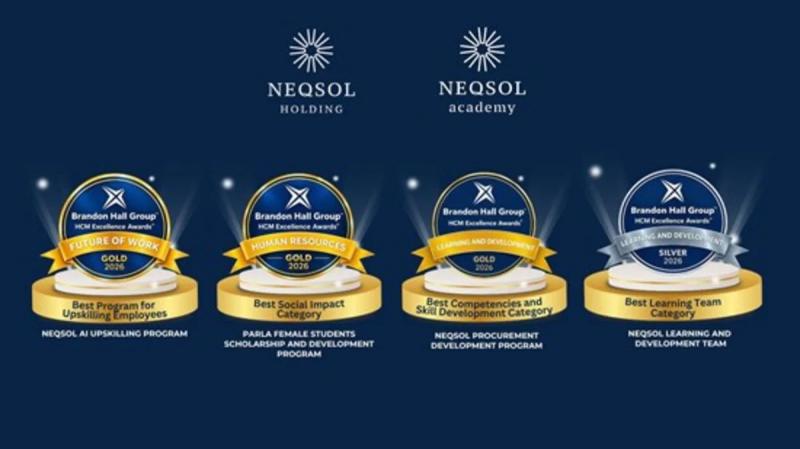
Four awards are nice. Gold is even nicer.
But what I particularly value about NEQSOL Holding’s recent recognition at the 2026 Brandon Hall Group HCM Excellence Awards is not the awards themselves. It is what sits behind them: a sustained investment in people.
Among the four awards, our AI Upskilling Program received Gold in the AI and Future of Work category. This is an area I care deeply about, because I think the conversation around artificial intelligence sometimes starts in the wrong place.
There is understandably a great deal of discussion about what AI will do to companies, industries and jobs. Which tasks will disappear? Which businesses will gain an advantage? How quickly will technology change the way we work?
These are important questions.
But I prefer another one: what can people do with AI when we give them the knowledge, confidence and freedom to use it well?
Technology Alone Does Not Transform a Business
Technology alone has never transformed a business. People do.
A company can purchase the best software available and still achieve very little with it. The real difference comes when people understand the technology, see how it applies to their work, experiment with it and gradually find better ways of doing things.
AI is no different.
In fact, because the technology is developing so quickly, the ability to learn may become more important than mastery of any particular tool. The applications we use today will change. New ones will appear. Some will prove useful and others will disappear remarkably quickly.
What remains valuable is curiosity, judgment and the habit of learning.
This is why I find the idea of preparing people before a capability becomes an urgent requirement particularly important.
Too often, organizations train people only after change has already arrived. A new system is introduced, a new process becomes mandatory, and employees are then taught how to adapt to it.
With AI, I believe we need to reverse the sequence.
We should give people an understanding of the technology early. Let them experiment with it. Allow them to discover where it is genuinely useful and where human judgment remains essential. Build confidence before there is pressure.
AI Skills Are Also Human Skills
The objective should not be to turn everyone into an AI specialist.
Most people do not need to understand how a large language model is constructed any more than they need to understand the engineering of a mobile network in order to use a smartphone.
They do, however, need to understand what the technology can and cannot do, how to work with it intelligently, and when not to trust it.
That last point is perhaps as important as the first two.
AI can produce an answer very quickly. It cannot remove our responsibility for deciding whether that answer makes sense.
So when we talk about AI skills, we should also be talking about judgment, critical thinking, professional expertise and responsibility. The more powerful our tools become, the more valuable these human qualities are likely to be.
This is also why AI development cannot sit only with technology teams.
The people who will discover some of the most useful applications are often those closest to the work itself: an engineer, a finance professional, someone in customer service, a lawyer, a project manager or a colleague working in human resources.
They understand the small inefficiencies and repetitive tasks that rarely appear in a technology strategy but collectively occupy enormous amounts of time.
Give those people the right tools and enough confidence to experiment, and transformation begins to happen from within an organization rather than being imposed from above.
The Real Advantage Is a Culture of Learning
Of course, this requires more than an AI training course.
It requires a culture in which learning is continuous.
Alongside technical capabilities, we still need to invest in leadership, professional development, communication and the ability to work across disciplines. AI does not make these skills less important. In many ways, it makes them more important.
There is another reason I think about this in longer terms.
Companies naturally compete for technology. We invest in infrastructure, platforms, software and increasingly compute. These investments matter.
But technology becomes widely available remarkably quickly.
The harder advantage to reproduce is an organization in which thousands of people know how to learn, adapt and apply new technology intelligently.
That takes years to build.
It comes from creating opportunities for people to develop, from encouraging curiosity and from making education part of the normal life of a company rather than something that happens occasionally in a classroom.
This is why the recognition of our AI Upskilling Program means something to me beyond the Gold award itself. It sits alongside our broader work in leadership development, professional skills and continuous learning.
The Capabilities Behind the Awards
Ultimately, that is where I believe much of the value from AI will come from.
The companies that benefit most from artificial intelligence will not necessarily be those that buy the most technology.
They will be those whose people learn fastest, ask better questions and put the technology to work intelligently.
Awards are a welcome recognition of that effort.
The capabilities we build behind them are the real prize.