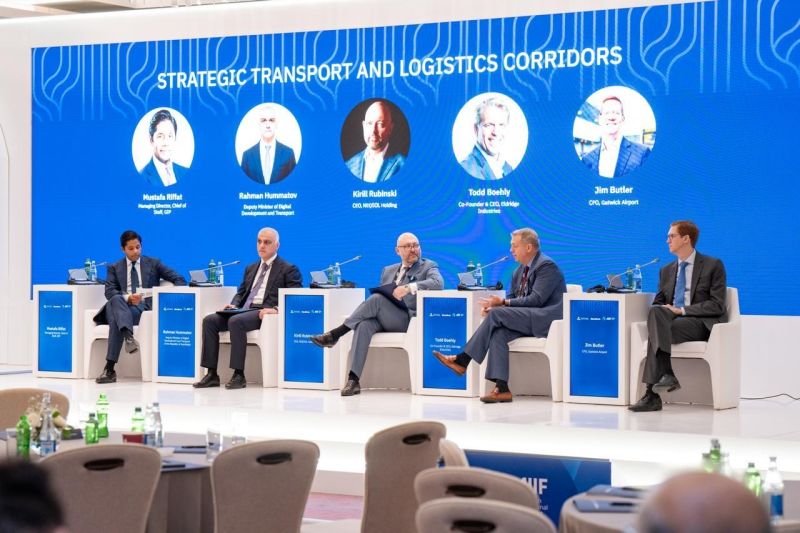
At the Azerbaijan International Investment Forum in Baku, I recently took part in the Azerbaijan Infrastructure Investment Dialogue and a discussion on strategic transport and logistics corridors.
The setting was appropriate. AIIF 2026 focused on connectivity and investment in an increasingly fragmented global economy, while the Infrastructure Investment Dialogue brought together perspectives on digital infrastructure, energy, transport and logistics.
One point I emphasized during our discussion is that I believe our definition of connectivity now needs to evolve.
For a long time, we have thought about economic corridors primarily in terms of physical transportation: railways, roads, ports, airports and the movement of goods.
All of these remain fundamental.
But the most competitive corridors of the future will increasingly need to move several things at once: goods, energy, data and capital.
And that changes what it means to build infrastructure.
From a Transport Corridor to an Economic Corridor
The Middle Corridor is a good example.
Running across Central Asia, the Caspian Sea, Azerbaijan and Georgia towards Türkiye and Europe, it has become an increasingly important east-west transport route. It combines rail and maritime infrastructure and connects some of the world’s major production and consumer markets.
Its development in recent years has been significant. Transit freight through Azerbaijan exceeded 9.1 million tonnes in the first seven months of 2026, with volumes on the East-West corridor increasing by 16.5% compared with the same period a year earlier. Capacity is also being expanded at the Port of Alat and elsewhere along the route.
These investments matter. Efficient railways, ports, border crossings and logistics centres will remain the backbone of the corridor.
But I think the larger opportunity begins when we stop seeing the Middle Corridor only as a way of moving containers between Asia and Europe.
A corridor can also become a platform around which economic activity develops.
For that to happen, transport infrastructure increasingly needs to be accompanied by energy infrastructure, digital connectivity and investment.
Adding a Digital Dimension
This is particularly relevant to digital infrastructure.
Every modern economy depends on the movement of data just as surely as it depends on the movement of physical goods. Cloud services, financial systems, telecommunications, artificial intelligence and increasingly industrial production all rely on resilient international connectivity.
The geography of fibre therefore matters.
At NEQSOL Holding, this is the thinking behind the Digital Silk Way and the Trans-Caspian fibre-optic connection.
Our aim is to help create a new digital route connecting Central Asia through Azerbaijan towards Europe and international digital markets.
The logic has something in common with the Middle Corridor itself.
Global networks are stronger when they have genuine alternatives. Additional routes create resilience, increase competition and reduce dependence on a limited number of geographic pathways.
But there is another dimension that I find equally interesting.
Once reliable, high-capacity digital infrastructure exists along a corridor, the economic opportunity is no longer limited to transmitting data from one end to the other.
Connectivity can begin to attract activity around it.
Data centres become more viable. Cloud infrastructure can develop. Technology businesses gain better access to international markets. Companies can locate operations closer to new centres of connectivity.
In other words, the value of a digital corridor should not be measured only by the traffic passing through it.
It should also be measured by what develops alongside it.
Beyond Transit
This distinction between transit and economic development is important for Azerbaijan.
Geography has always been an advantage. Azerbaijan sits between Central Asia, the South Caucasus, Türkiye and Europe, with established transport and energy connections across the region.
But geography alone does not create an economic hub.
Infrastructure has to be combined with investment, institutions, skills and commercial activity.
The opportunity, therefore, is not simply to become more efficient at moving goods, energy or data from one border to another.
It is to create conditions in which some of the value associated with those flows remains in the country and the wider region.
A container may spend only a short time crossing Azerbaijan. A technology company, data centre, logistics business or industrial operation can stay for decades.
That is a very different kind of economic value.
It is also why I believe transport, energy and digital infrastructure should increasingly be considered together.
Each strengthens the others.
Reliable transport enables trade and manufacturing. Energy supports industry and compute. Digital networks connect businesses to customers, markets and information. Capital provides the means to build and expand all three.
When these systems develop alongside one another, a corridor starts to become something more substantial: an economic platform.
Infrastructure Is Ultimately About Options
There is also a broader lesson here.
Much of the infrastructure debate naturally focuses on capacity: more freight capacity, more railway lines, more port terminals, more electricity generation, more fibre.
Capacity matters.
But resilience and competitiveness depend on something else as well: options.
Can businesses reach markets through more than one route?
Can energy move between different systems?
Can data travel through genuinely diverse networks?
Can investors deploy capital into an ecosystem rather than a single infrastructure asset?
These questions are becoming more important as companies reconsider supply chains and governments pay greater attention to economic resilience.
The Middle Corridor therefore has an opportunity to develop not simply as an alternative transport route between East and West, but as a more integrated form of connectivity.
That will require significant coordination. Infrastructure crosses borders, regulatory systems and commercial interests. No single government or company can build an international corridor on its own.
Which brings me back to one of the simplest conclusions from our discussion in Baku.
Infrastructure creates connectivity.
Partnership is what turns connectivity into economic value.