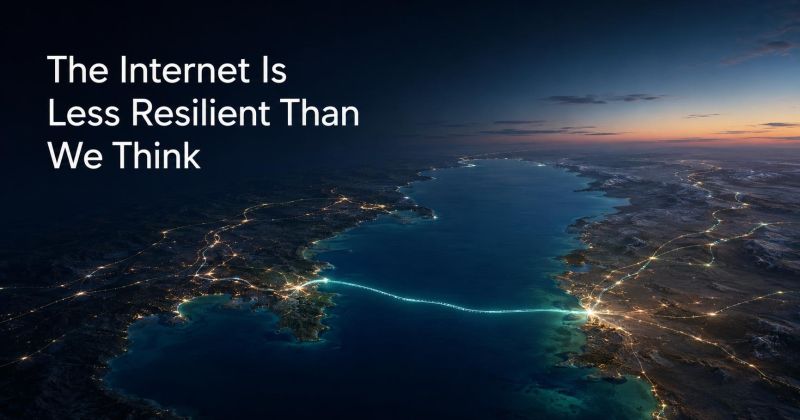
The internet feels intangible, but its vulnerabilities are surprisingly physical.
A shovel cutting through a fibre-optic cable can disrupt connectivity across a country. An anchor dragging across the seabed can threaten communications between continents. A single point of failure, in the wrong place, can have consequences far beyond the immediate geography.
These incidents are reminders of a structural weakness in the digital economy. We have built more fibre, more network capacity and more sophisticated infrastructure than ever before. Yet much of that infrastructure still follows the same geography, passes through the same chokepoints and depends on the same jurisdictions.
More infrastructure, in other words, does not necessarily mean greater resilience.
What matters is diversity: genuinely independent routes, different physical paths and credible alternatives when one part of the system is disrupted.
For traffic between Asia and Europe, this question has become particularly important. Two established corridors have traditionally carried much of the connectivity between the two regions. Both remain essential. But physical disruption, geopolitical change and regulatory uncertainty have made the case for a credible third route considerably stronger.
This is the thinking behind the Digital Silk Way.
The ambition is to create an additional digital corridor connecting Asia and Europe through Central Asia, the Caspian Sea, the South Caucasus and Eastern Europe. It is not intended to replace existing routes. Its purpose is to add something that modern digital infrastructure increasingly requires: another real option.
A recent milestone was the laying, together with Kazakhtelecom, of the first submarine fibre-optic cable across the Caspian Sea between Azerbaijan and Kazakhstan. It is an important piece of infrastructure, both technically and symbolically. For the first time, the two sides of the Caspian are being linked in this way as part of a broader east-west digital route.
But a cable is not yet a corridor.
That distinction matters.
A true digital corridor has to work end to end. It must connect infrastructure across borders, operators and jurisdictions. It requires interoperability, coordinated investment, predictable regulation and commercially viable services. Most importantly, customers need to be able to rely on it not as an interesting engineering project, but as a practical alternative.
The challenge is therefore as much institutional and commercial as it is technical.
This is also why the significance of the Digital Silk Way extends beyond telecom traffic.
The rapid development of artificial intelligence is changing the geography of digital infrastructure. AI requires enormous amounts of compute, storage and connectivity. Data centres, cloud platforms and digital services increasingly depend on access to reliable, high-capacity networks.
Connectivity will therefore play a growing role in determining where the digital economy can develop.
Regions that sit along strong, resilient digital corridors have an opportunity not simply to carry data, but to attract the infrastructure and businesses that depend on it. Data centres can follow. Cloud services can expand. Technology companies can invest locally. New digital businesses can emerge around the network itself.
For Central Asia and the South Caucasus, this creates an opportunity to move from being seen primarily as transit geography to becoming part of the digital economy’s underlying architecture.
That transition will not happen automatically. Fibre alone does not create an ecosystem. It requires investment, skills, competitive markets, predictable regulation and long-term cooperation between governments and private operators.
But the physical network is an important starting point.
There is a broader lesson here for infrastructure investment.
For many years, capacity was often the dominant measure of progress: more cables, more bandwidth, more throughput. Those measures still matter, particularly as global data consumption continues to grow.
But resilience requires a different question.
How many genuinely independent options does the network provide?
If several cables pass through the same narrow geographic corridor, depend on the same landing points or are exposed to the same political and regulatory risks, the apparent redundancy may be less meaningful than it looks.
The next generation of infrastructure should therefore be judged not only by how much fibre we build, but by how much real choice we create within the network.
In a world where economic activity, public services, finance, communication and increasingly artificial intelligence all depend on uninterrupted connectivity, diversity of routes is no longer a technical luxury.
It is becoming part of the basic architecture of economic resilience.