There is a tendency to describe infrastructure in visible terms, rail, ports, pipelines.
Digital infrastructure, by contrast, is rarely seen, yet increasingly defines how systems function.
The Trans-Caspian fiber optic cable sits precisely in that category.
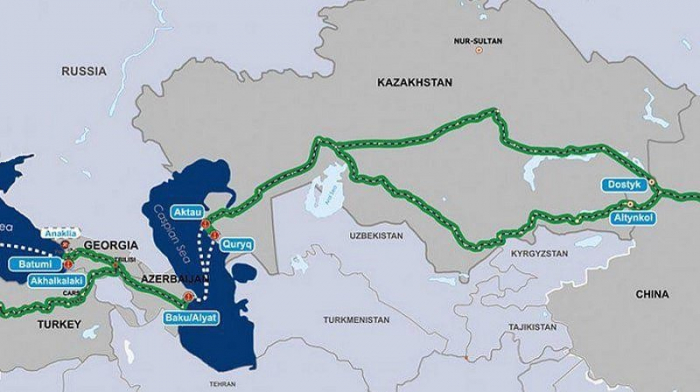
At one level, it is a 380-kilometer connection between Aktau and Sumgayit, developed together with our partners at Samruk-Kazyna and Kazakhtelecom. At another, it is part of a broader effort to introduce additional resilience into the global flow of data, something that has become less theoretical in recent years.
In my discussions with Nurlan Zhakupov, the focus was not limited to the asset itself, but to its trajectory.
Infrastructure of this kind is rarely static.
Once a route exists, it begins to attract adjacent uses.
The alignment with the Middle Corridor is a logical extension. Trade routes, historically, have always evolved beyond their initial purpose. What begins as a logistics pathway tends, over time, to develop into a broader economic framework.
Introducing a digital layer to an existing transport corridor is not a reinvention.
It is a form of completion.
Data, like goods, follows paths of least resistance, but also of greatest reliability. In that sense, redundancy is not excess capacity, it is a structural requirement.
From the perspective of NEQSOL Holding, the question is less about scale and more about durability.
Where infrastructure is concerned, timing is rarely perfect.
Demand often becomes fully visible only after capacity is in place.
We are already seeing indications of this. There is consistent interest from international technology companies in alternative routes, not necessarily to replace existing ones, but to complement them.
The Caspian crossing offers precisely that, a geographically distinct corridor, positioned between established systems.
The discussion around its potential role within frameworks such as TRIPP adds a more political dimension. These initiatives can accelerate connectivity, but they also introduce variables that are difficult to model over the long term.
In practice, infrastructure tends to outlast the context in which it is announced.
What matters, therefore, is whether it remains useful across different scenarios.
Projects like this do not transform regions overnight.
They create conditions.
Conditions for data centers.
For regional digital hubs.
For a degree of technological autonomy that is often understated but increasingly relevant.
Much of this work will remain in the background.
If it functions as intended, it will not draw attention to itself.
It will simply be used.
And in infrastructure, that is usually the most reliable measure of value.