Art fairs are moments of intense visibility. Walking through Paris or Miami during Art Basel, one is surrounded by confidence—finished works, established narratives, prices that signal validation. From the outside, the art world can appear self-assured, even impermeable.
But beneath that surface lies a far more fragile reality.
What we see at major fairs is the end of a long and uncertain process. For every artist whose work hangs confidently on a booth wall, there are years, often decades, of doubt, experimentation, financial instability, and quiet perseverance. The distance between talent and recognition is neither linear nor guaranteed.
This is where responsibility begins.
Beyond Taste and Acquisition
Supporting artists is often misunderstood as an extension of personal taste or collecting ambition. In reality, the most meaningful support rarely has anything to do with ownership.
At critical moments in an artist’s trajectory, what matters most is not the acquisition of a work, but the reinforcement of confidence, visibility, and continuity. A recommendation to the right curator, an introduction to a serious gallery, participation in a carefully chosen exhibition, these gestures often carry more weight than a transaction.
They are also harder to quantify, which is precisely why they matter.
Just as in long-term investing, timing is everything. Intervention too early can distort. Too late, and it becomes symbolic. The role of a private supporter is to understand that narrow window where encouragement can change momentum without imposing direction.
The Parallel With Long-Term Investment
There is a clear parallel between supporting emerging artists and investing in people rather than projects. In both cases, outcomes cannot be engineered. They must be allowed to unfold.
Markets, financial or cultural, are often impatient. They reward immediate signals and visible traction. Yet artistic development resists acceleration. Style matures through repetition and failure. Voice emerges through doubt. External pressure to “perform” too early can be as damaging as neglect.
Those who engage with art only at the level of established success miss this entire dimension. Presence at major fairs is important, but it should not be mistaken for understanding the ecosystem as a whole.
Visibility Is a Form of Capital
In the art world, visibility functions as a form of capital: scarce, unevenly distributed, and highly consequential. Institutions play a role, but they move slowly and cautiously. Private individuals, by contrast, can act decisively and discreetly.
This discretion is essential. Support should never overshadow the work itself. The most effective contributions are often invisible to the public but deeply felt by the artist. They preserve autonomy while reducing vulnerability.
In that sense, supporting artists is not an act of generosity. It is an acknowledgment of interdependence. Cultural ecosystems survive because individuals choose to carry responsibility where institutions cannot.
Continuity Over Spectacle
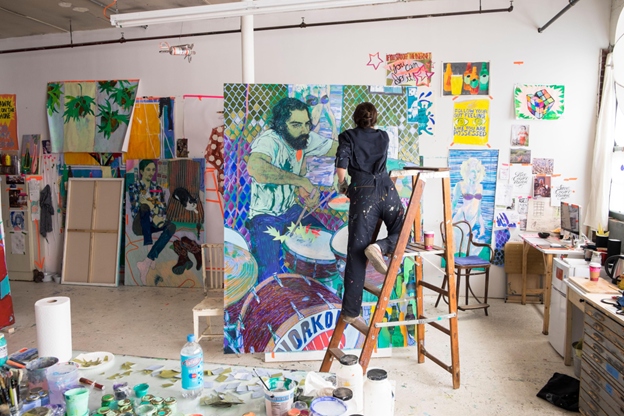
Large international events remind us of art’s global language, but continuity is built elsewhere; in studios, small exhibitions, and conversations that never make headlines.
Remaining engaged beyond the spectacle matters. It signals seriousness. It creates trust. And it allows relationships to develop organically, without expectation of immediate return, financial or reputational.
This approach requires restraint. It resists the temptation to turn culture into performance. But over time, it is the only way to contribute without distorting what one claims to support.
A Quiet Obligation
Those who have the means to support artistic creation inevitably influence its future. The question is not whether that influence exists, but how consciously it is exercised.
Cultural continuity does not depend solely on museums or markets. It depends on individuals who understand that art, like capital, compounds slowly, and that responsibility lies not in control, but in stewardship.
Supporting artists, then, is neither patronage nor charity. It is a quiet obligation to the future of culture itself.